
Home
Page
All about Rakaposhi
Testimonial Pakistan in Pictures
Trade Related Links
Suggested
Itineraries
Contact Rakaposhi Tours |
|
 |
PAKISTAN, THE LAND
OF HISTORY
The landmass that we call Pakistan today became an Independent country
on the 14th August 1947, yet it enjoyed a measure of unity for millennia.
Tools dug out in the Soan valley near Pakistan's capital Islamabad show
that human beings lived in organized communities more than two million
years ago.
|
The "dead" city of Moenjodaro some 510-km form Karachi
was a metropolis in a civilization that thrived upon a landmass roughly
co-extensive with present day Pakistan. The bath-loving people of this
city, representative of that age, had a highly developed municipal system,
large neat and clean streets, excellent granaries, able jewelers, dyers,
clothiers, and town planners. From the river port of this city, cotton
spices and silk were exported to contemporary empires in Africa and the
Arab world.
The city of Mehargarh was already five thousand years old when Alexander
the Great invaded ancient Pakistan in 326 B.C. From the figurines unearthed
during excavation, it appears that the beauticians and coiffeurs in this
city were highly skilled. Women had a fantastic array of hair-dos, wearing
their hair in large locks and curls. Such ladies of distinction could only
have lived in neat and orderly houses.
When Buddha finally broke his six-year silence, it was here that his
message was first received and spread by the faithful. Relics dug out from
the old Buddhist can be seen in Karachi, Lahore, Taxila and Swat museums.
|
Alexander the Great fought almost all his wars in South
Asia in the land of present-day Pakistan. Amongst the many Kingdoms that
flourished in ancient Pakistan, was Gandhara. The geographical boundaries
of this kingdom were the same as those of the present-day districts of
Rawalpindi, Peshawar and Swat. The kingdom is very highly renowned for
its architecture and sculpture.
Islamization of Pakistan begun with the invasion of Mohammad Bin Qasim's
army in 712 A.D. The young Arab general conquered a vast region right from
the sea-board of the present-day Karachi to the banks of the Chenab River.
Mahmud of Ghaznavi (1020 AD) Muhammad Ghauri (1192 AD) and Zaheer-ud-Din
Babar (1526 AD) attacked the areas that make present-day Pakistan.
The Mughal Empire founded by Babar produced four brilliant kings. Akbar,
Jeha-gir, Shah Jehan and Aurangzeb. They left behind a legacy of some of
the most beautiful buildings in the world, a treasured asset of mankind.
Aryans, Greeks, Scythians, Iranian nomadic people from South Asia, Parthi
|
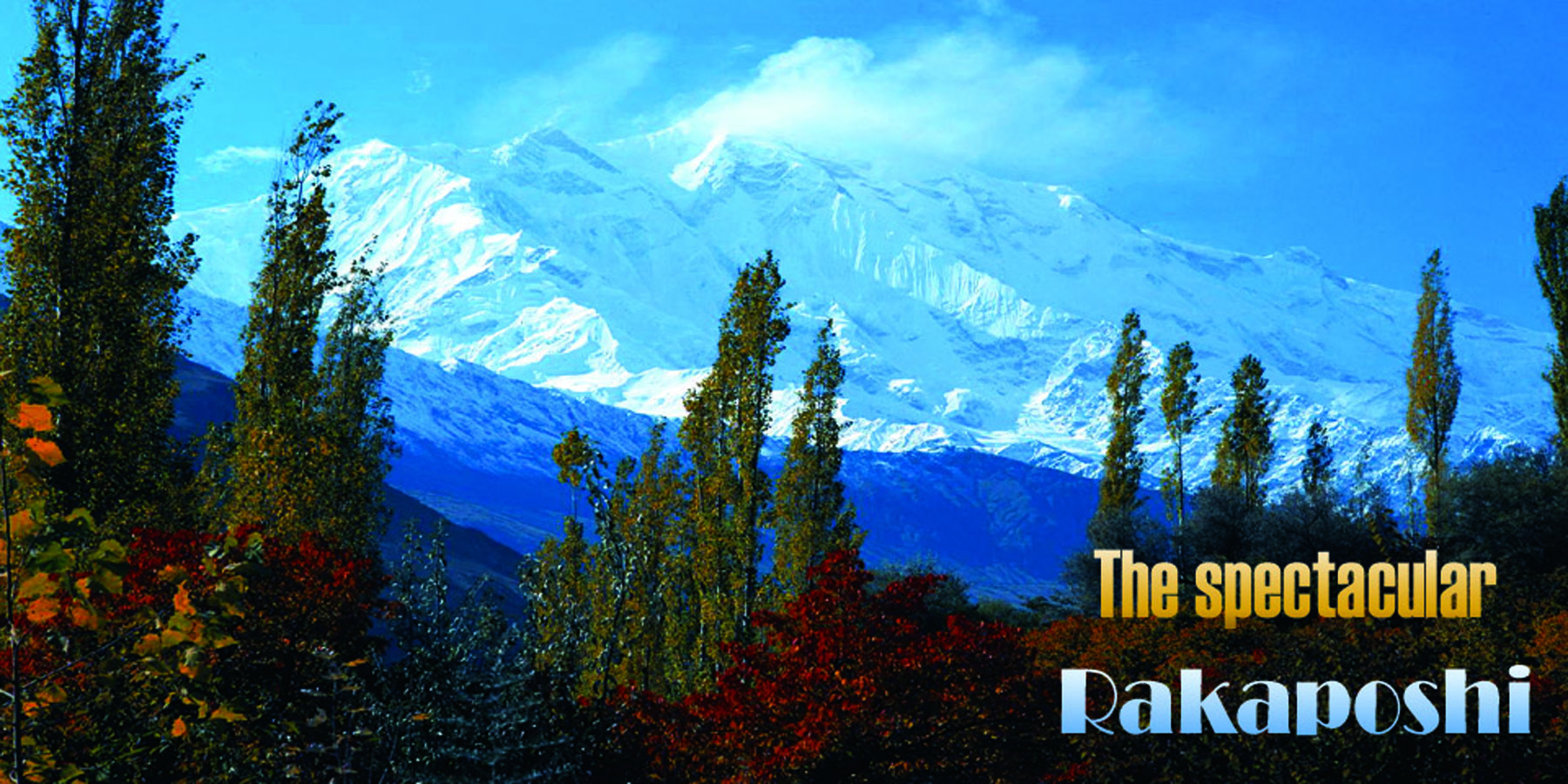
PAKISTAN, THE LAND OF MOUNTAINS
All that nature has bestowed upon mankind is in Pakistan: lakes, rivers,
streams, seas, deserts, glaciers, forests and meadows. Some 2000 kinds
of flowering trees and shrubs grow here. The variety of fruit that grows
here probably does not grow in any other country of the world. In Pakistan's
north are some of the most beautiful and spectacular mountains in the world.
Their character can be judged from the fact that five peaks in these
mountains are over 8000 m, and dozens literally dozens over 7000 m high.
The Karakoram have some of the mightiest glaciers outside the Polar
Regions. The Siachin glacier is 75 Kms long. The Hispar joins Blafo to
make up a 116 Kms long system. the dramatic Baltoro glacier that spreads
over 120 Sq. Kms is fed by some 30 other glaciers. Along the fantastic
course of the Abaseen, the father of the rivers, the mighty Indus runs
753 kms along the 8th wonder of the world, the Karakoram Highway (KKH).
This most daring feat of engineering took thou-sands of lives and hundreds
of thousands of tonnes of dynamite to blast the rocks to forge ahead. The
highway follows the ancient Silk Route Thordden upon by legendary travelers
like Marco Polo and one camel caravan after another groaning under the
weight of silk, gold, jade rubles and pink corals, for thou-sands of years.
KKH connects Islamabad/Rawalpindi with the Xinjiang province crossing over
the 4600 m Khunjrab Pass, perhaps the highest pass of commercial importance,
to China.
Still virtually unspoilt, the Northern Areas of Pakistan provide an
exhilarating choice for travelers who demand the unusual and the spectacular.
The region has a fascinating and varied language and cultural mix. In Baltistan
(land of the apricots), Tibetan culture and language has left a strong
imprint. In Hunza alone three languages are spoken. Wakhi and Brushuski
are two of them. Brushuski is spoken with a different accent in Nagar just
20 miles away. |
|